Image

UltraTube Product & Fabrication Guide

Engineered for strength
Trusted for safety
Optimised for efficient fabrication

Image

About UltraTube™

UltraTube™ is a high-performance steel tube made from advanced dual-phase (DP) steel. Its ferrite–martensite microstructure offers a unique combination of high strength, good ductility, and excellent weldability.

UltraTube™ is designed for weight-efficient designs in motorsport, off-road, automotive, and safety-critical applications where strength, reliability, and fabrication ease are essential. Its dual-phase microstructure offers the strength and formability required for complex geometries that are often difficult to manufacture using conventional alloyed high-strength steels.

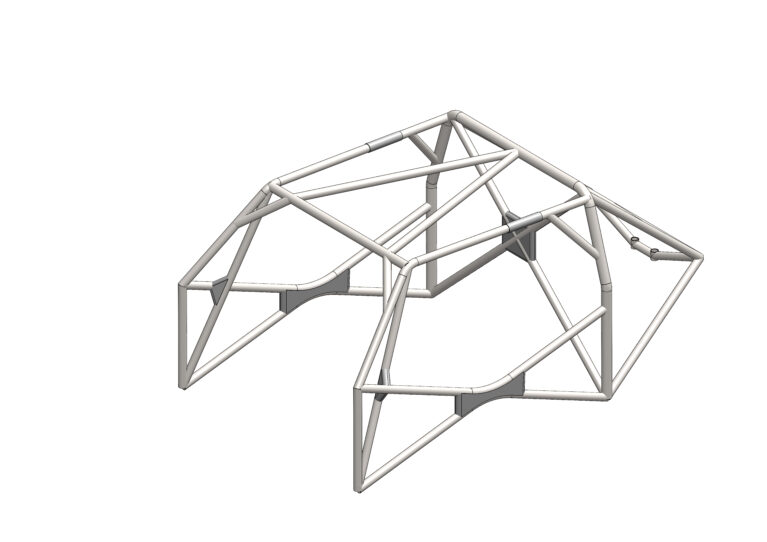
The mechanical characteristics of UltraTube™ – high energy absorption, excellent fatigue resistance, and consistent performance – make it well-suited for safety cages, space frames, commercial vehicle fit-outs and heavy-duty off-road accessories. Its ability to deform in a stable, controlled manner helps maintain a low deceleration pulse during impact, improving crash performance and occupant protection.

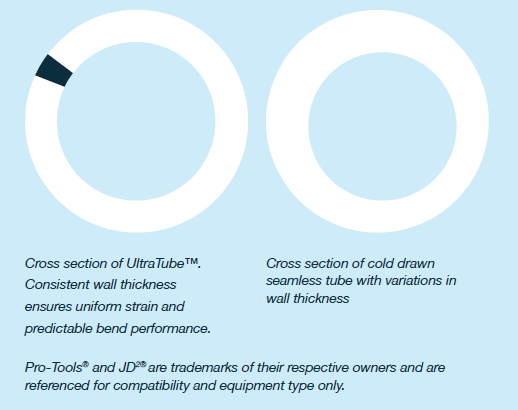
Dual-phase steels exhibit continuous yielding, transitioning gradually from elastic to plastic deformation rather than showing a distinct yield point. This results in more predictable behaviour during both forming and impact scenarios. The cold-rolled coil used to manufacture UltraTube™ is produced through intercritical annealing on a continuous annealing line (CAL). This process precisely controls phase transformations to achieve the dual-phase structure, ensuring uniform thickness and consistent mechanical properties throughout the coil and into the final tube.

Industrial Tube Manufacturing’s precision tube-forming process uses high-frequency induction (HFI) welding to produce a tube with excellent dimensional accuracy, a minimal internal weld bead, and a narrow and controlled heat-affected zone (HAZ). The result is a clean, consistent tube optimised for demanding applications where strength and reliability matter most.

Product Specification

Two UltraTube™ variants are available: UltraTube™ for general fabrication and UltraTube RS™ for motorsport.

UltraTube™ can be produced in circular profiles from 22.2 to 76.2 mm, with minimal MOQs. It delivers high strength, tight dimensional control, and a smooth cold-rolled surface suited to precision fabrication. As with all high-strength structural steels, forming, welding and joint detailing should be carefully considered and controlled to preserve material properties across fabricated assemblies. UltraTube™ enables lightweight, efficient structural designs without compromising reliability or ease of manufacture.

Tolerances and delivery conditions

Manufactured in New Zealand to the delivery and dimensional requirements of AS 1450 and EN 10305- 3, with mechanical properties verified per the UltraTube™ specification and mill test certificate (MTC). Delivery is to EN 10131:2006 Class B thickness tolerances, with a tight, symmetric range. Tensile testing for UltraTube RS™ is to AS 1391:2020 and base steel meets the mechanical requirements of EN 10338:2015 (cold-rolled dual-phase). Each UltraTube RS™ order is supplied with an MTC and is fully traceable. Tubing is linemarked for easy identification.

Typical imperial mechanical-tubing standards—ASTM A513, ASTM A519, and AMS-T-6736—specify wall-thickness tolerances of ± 10%. UltraTube™ 1.6mm and 2.0mm nominal
gauges are targeted to align with 0.065” and 0.083” sizing while remaining compliant with EN 10131 tolerances. Minor variation may occur between coil batches.

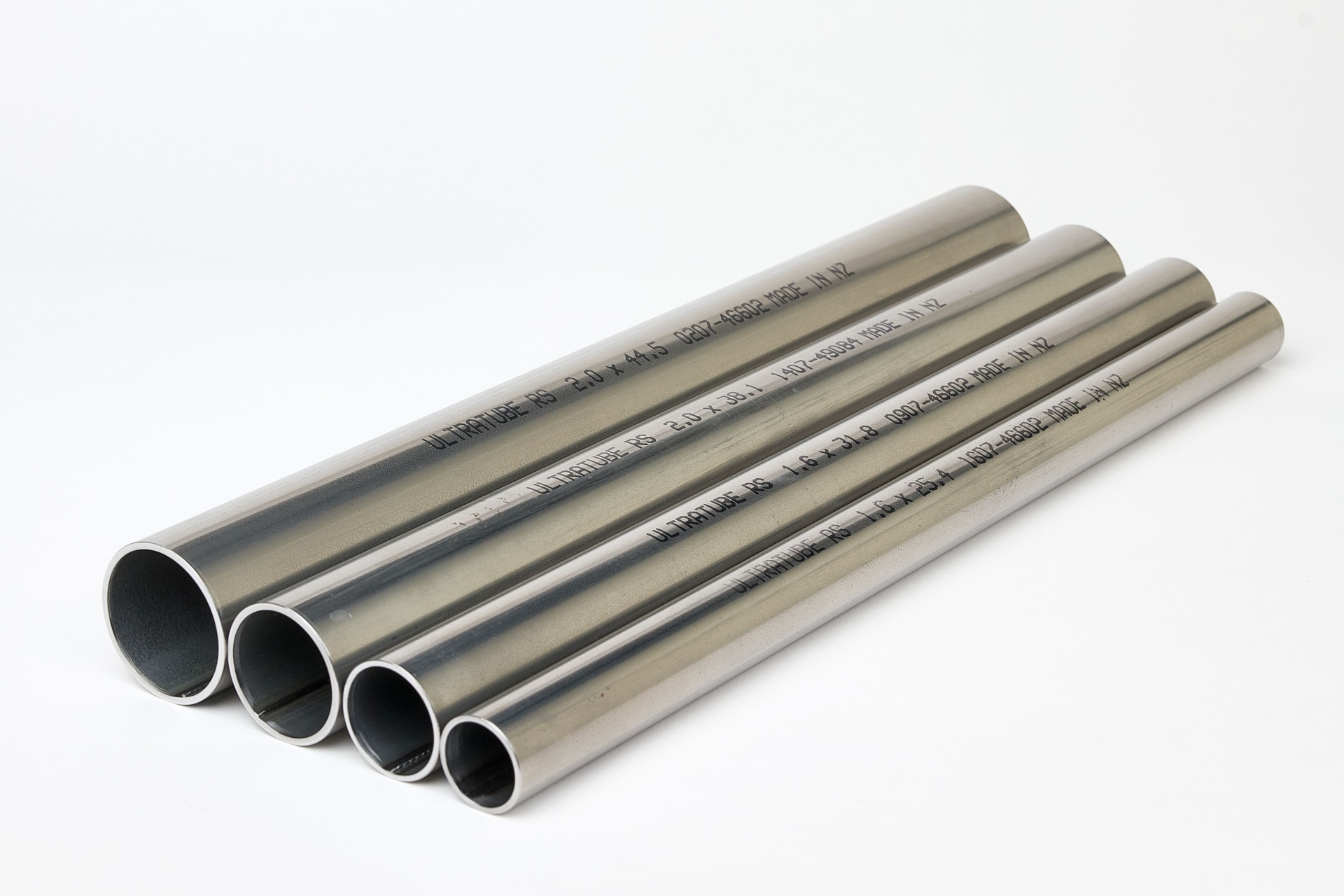
UltraTube RS™ Typical Mechanical properties
Yield strength Tensile strength HRB (Hardness) EI % on Lo=50mm
690 MPa 850 MPa 104 17
UltraTube RS™ Chemical Composition (Ladle analysis)
C (max%) Mn (max%) Si (max%) P (max%) S (max%) Cr+Mo (max%) AI (min%) Ni (max%) Ti (max%)
0.100 2.000 0.280 0.023 0.005 0.260 0.015 0.075 0.007

Welding UltraTube™

UltraTube™ offers good weldability with a relatively low carbon equivalent (CE) value, low impurities, and a clean, smooth, oxide-free surface. All common welding techniques can be used, and UltraTube can be welded to other steel grades.

A key advantage when fabricating automotive chassis and safety-cage components is UltraTube™ ’s lower sensitivity to heat affected zone (HAZ) hardening and cracking, issues that can occur in alloyed steels such as 4130 CrMo when welding procedures are not tightly controlled. As with all high-strength structural steels, qualified welding practices and post-weld inspection remain essential to ensure weld quality and structural integrity.

Dual Phase steels contain alloying elements of around 3%, influencing electrical and thermal behaviour. Higher electrical resistivity increases heat at the arc and lower thermal conductivity slows dissipation. The weld puddle may appear broader and more fluid, with a slightly wider HAZ than 4130 CrMo. With proper technique, the likelihood of imperfections is comparable to other common steels. UltraTube™ is supplied with a light protective oil coating, which vaporises during welding and does not cause porosity.

For motorsport applications, this advice should be read in conjunction with the published welding requirements of each sanctioning body.

Filler Material

For fillet welding of UltraTube™ using MIG or TIG, we recommend AWS ER70S-6 (solid wire/rod; undermatched). ER70S-2 may also be used for TIG where preferred by the operator. Where higher weld-metal strength is required, ER80S-D2 is recommended, while ER90S-D2 or ER100S-G should only be applied when explicitly required by a qualified WPS.

CrMo “B-series” fillers (e.g., ER80S-B2, ER90S-B3) must not be used, as their chemistry is incompatible with UltraTube™ and may result in unsuitable weld/HAZ properties.

Welding Procedures

UltraTube™ is a Dual Phase steel. Do not apply post-weld heat treatment (PWHT), as it will temper and soften the base material. For MIG (GMAW), use stringer beads with controlled, low heat input and avoid weaving.

Suggested settings using ER80S-D2:
Thickness Amps V/W Notes
MIG (GMAW) – 0.9 mm wire, 90% Ar / 10% CO₂ 1.6mm 75-110A 17-21 V Short-circuit preferred
2.0mm 90-130A 18-22 V Can use pulsed/ spray transfer
TIG (GTAW) – 1.6 mm filler, 100% Ar
1.6mm 50-80A 1.6mm, sharp Foot pedal or pulser helpful
2.0mm 70-100A 2.4mm, sharp Keep arc short, steady angle
For ER70S-2 and ER70S-6, start within the same current/voltage windows and fine-tune for arc stability, bead shape, and operator preference

Bending & Forming UltraTube™

UltraTube™ can be bent using most tube bending equipment. We recommend using a mandrel tube bender; however, manual and hydraulic rotary-draw benders such as Pro-Tools or JD² can also be used, producing results similar to bending 4130 CrMo or BS4 T45 tubing.

UltraTube™ exhibits springback on bending similar to 4130 CrMo, requiring over-bend to achieve the desired final angle. The amount of springback depends on OD × wall, bend radius, and setup, so it should be established with trial lengths for each die set and recorded as a shop setting.

Mandrel bending delivers the best control of ovality and surface finish, especially on thin walls (e.g. 1.6mm) and bends exceeding 60°. The weld seam should be positioned in the neutral axis. A bend radius ≥ 3 × OD is generally recommended. With appropriate mandrel + wiper tooling and a well-set rotary-draw process, 2D CLR bends up to 180° sweep are feasible on most UltraTube™ sizes. Feasibility depends on OD, wall, die condition, and setup.  Trial bends should be used to verify post-bend ovality and OD against applicable quality requirements or the relevant rulebook.

Non-mandrel rotary-draw (Pro-Tools / JD² / similar)

• Die selection: Use precision-matched OD dies and followers sized for the wall thickness; poor fit causes flattening and wrinkling.
• CLR choice: Prefer larger CLR (≥ 3 × OD) for thin-wall bends; tighter radii demand more clamp force and increase ovality.
• Setup discipline: Clean dies, lubricate contact points, and set adequate clamp and pressure-die force to prevent slip and scoring.
• Technique: Make smooth, continuous pulls; avoid stop–start that imprints flats. Expect springback – overbend and verify with a digital angle gauge; record the value for each die set and material.
• Quality checks: Measure ovality and wall thinning at the outer radius (tensile side); inspect for wrinkling at the inner radius (compression side); deburr and inspect the longitudinal seam in the bend zone.
• Thin-wall note: For 1.6 mm walls or angles > 60°, non-mandrel bending is feasible with good dies and generous CLR, but mandrel/wiper tooling gives more consistent results and lower ovality.

Not recommended

• Heat-assisted/torch bending of Dual Phase steels (risk of local tempering).
• Packed-sand or low-melt alloy methods intended for hot bends – UltraTube is designed for cold bending with proper tooling.

Mandrel bending

Use mandrel + wiper tooling for thin walls, tight radii, or when ovality must be minimised. Bend cold (no heat).  UltraTube exhibits the normal springback expected from a
high-strength steel – establish the required over-bend on trial lengths and verify post-bend dimensions/ovality against the relevant quality standard or rulebook.

Coating UltraTube™

UltraTube™ is a cold-rolled product with a smooth, consistent surface finish suitable for most types of coatings, including paint, powder coating, zinc plating, and zinc-rich primers.

The fine surface texture achieved through cold-rolling provides excellent adhesion and uniform film build, making UltraTube™ ideal for both decorative and protective finishes.

A bake hardening effect occurs in the 160–220 °C range during a typical powder-coat curing cycle, increasing yield strength by approximately 20-40 MPa. This allows UltraTube™ to achieve a small but measurable gain in mechanical performance after finishing, while maintaining much of its underlying ductility.

Batch hot-dip galvanising is not recommended for UltraTube™ or other advanced high-strength steels. The process involves immersion at temperatures near 450 °C, which can temper the martensitic phase and reduce mechanical properties. Alternative corrosion protection options such as electro-galvanising, zinc-nickel plating, or zinc-rich epoxy primer systems are  preferred where enhanced durability is required.

For optimal coating results:

• Ensure all tube surfaces are free from rolling oil, weld scale, and handling residue before finishing.
• Pre-treatments such as alkaline cleaning, phosphate conversion, or nano-ceramic coating can improve adhesion and corrosion resistance.
• Bake cycles up to approximately 230 °C for typical powder-coating durations are acceptable for UltraTube™ . Avoid prolonged or repeated high-temperature exposure that could temper the martensitic phase.
• UltraTube™ may also be finished using liquid paint, zinc electroplating, or other compatible coating systems where appropriate surface preparation and curing controls are observed.
• For longer-term outdoor service, use a zinc-rich epoxy primer with a compatible topcoat system.

Starex
Howard Wright
Sustainable Stainless
NZ Made
Winter Garden NZ
NZ Steel Galvanised
Resero
Blue Scope NZ Steel
Chase | PitStop
Archgola
Blue Scope NZ Steel
Smokai

Turn your concept into a finished product — seamlessly

End-to-end manufacturing, streamlined. Design, prototyping, and production — all managed in-house for precision and control.